

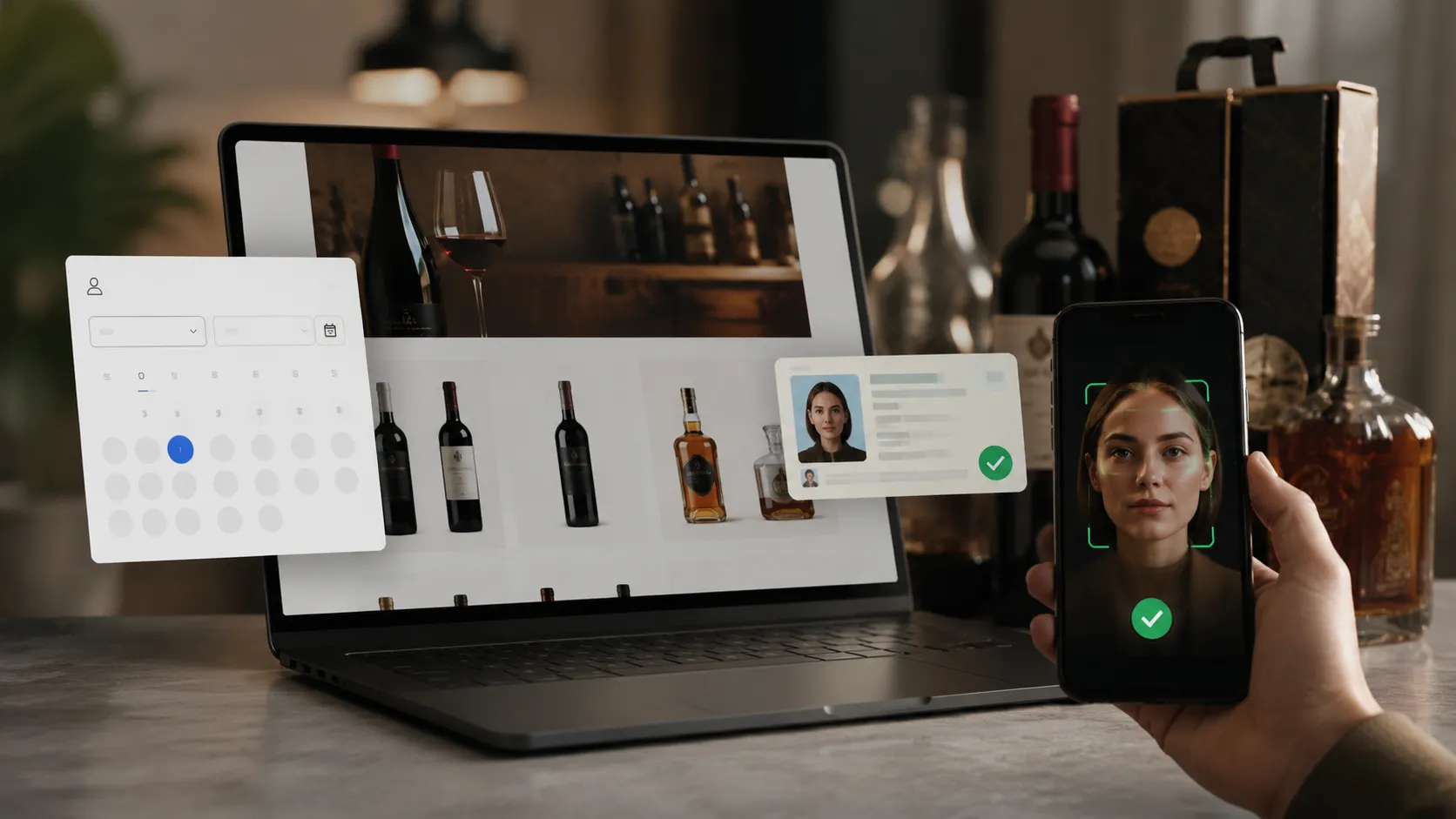
You’ve seen it a hundred times. You get to an alcohol delivery website, and a pop-up appears: Are you 18 or older? You click yes. You’re in.
That’s it. That’s all the check.
There was no verification. You replied that you were old enough, and the site accepted it. It takes a 14-year-old with a smartphone less than three seconds to do the same thing.
That’s the truth of age-gating on the majority of online alcohol sites today, and it’s an issue that’s increasingly hard to shrug off.
Clicking “Yes” Is Not the Same as Proving Your Age
What is known as an honor-based check is a date of birth field or a simple yes/no prompt. It assumes that people will give an honest answer. Spoiler: They don’t, particularly if it’s what they want on the other side of the gate.
Behind a checkbox, there’s no identity. No document. No face. Simply a number entered in a field by an unknown person who may be of any age.
Those alcohol platforms that attempt this are not alcohol age verification but rather alcohol age acknowledgment. This distinction is a big deal when regulators, parents, or courts knock on the door.
What Actually Happens When a Minor Orders Alcohol Online?
It’s easier than most platform operators will admit. A young person discovers an app to order alcohol.A youth discovers an app that delivers alcohol. They provide a birthdate that is after the legal age. They use a parent’s card or prepaid card. The order is delivered at the door.
No documents were checked at any time. At no point was a face matched to an ID. The platform would have collected income and taken compliance on board. The minor was given alcohol at their home.
This is not something of a hypothetical scenario. It’s a familiar trend in markets with online alcohol delivery services that have grown at a rapid pace, relative to regulation.
The Gap Between Compliance Theatre and Real Protection?
Here’s where platforms get themselves into trouble. Many think they have met their legal requirement with some sort of age gate, even a tick box. In some markets where enforcement is weak, they’ve been able to do that interpretation for years.
That window is now closing, however. The meaning of “reasonable steps” is becoming tighter and stricter across the UK, EU, India and beyond. A date of birth entry field is now regarded as not just a compliance requirement but a liability as a cloak.
Real age verification is when you know that the customer who ordered the product is real, and he/she is old enough to order the product. That involves verification of something which is not falsifiable by the keyboard.
What the Document Verification Process Actually Looks Like?
Here’s what happens when an alcohol platform incorporates a well-designed document verification process:
The customer is requested to present an ID card (passport, driving license or national ID card). The document is scanned and automatically analysed. The software verifies authenticity, alteration and date of birth in the document to ensure that the individual is legally able to use the service.
A few platforms extend the functionality and include a liveness test – the customer takes a quick selfie that is then compared with the image on the document. The loophole that someone could submit a borrowed or stolen ID is now closed.
It is a very quick process, taking only seconds. Only occurs during account creation or on initial purchase. From then on, the platform will have a proven history of the customer being of legal age.
This is a completely different issue from a box to be ticked.
Why “KYC Documents” Aren’t Just for Banks Anymore?
For most people, KYC documents, which include passports, driver’s licenses, and utility bills, are synonymous with banks and financial services. The association was logical back then, when KYC was just a financial compliance issue.
That’s not the case anymore. When it comes to age-restricted sales, the same should be applied to any platform offering such sales, as the bank knows who its customers are. You must be certain that your customer is genuine, is who they say they are, and that they are of legal age to purchase your product or service.
Financial institutions have been facing this compliance challenge for years, and alcohol platforms are facing it as well. There are now tools available to do this at scale, and it requires minimal friction for true adults.
The Experience Doesn’t Have to Be Painful
The biggest objection that has been raised from alcohol platforms is that real verification will cause a drop-off. No customers will finish what you’ve begun. Conversions will fall.
This is a valid concern, but one that is growing out-of-date. Modern online age verification checks are intended to be quick and simple and to be mobile-friendly and low-friction for the majority of users who are legal adults. Most adult customers complete the verification process seamlessly when it’s integrated into the onboarding or checkout process.
Obviously, if they drop off at a real verification step, they are the ones that you shouldn’t be servicing.
The Bottom Line for Alcohol Platforms
A date of birth field protects no one. It doesn’t protect minors from accessing alcohol. It doesn’t protect your platform from regulatory action. It doesn’t protect your brand when a journalist or regulator decides to test your system.
Document-backed age verification does. It creates a verifiable record that you took reasonable steps. It deters minors who cannot produce a genuine ID. And it signals to regulators that your platform takes its obligations seriously rather than performing them.
The checkbox had its era. That era is ending.
