
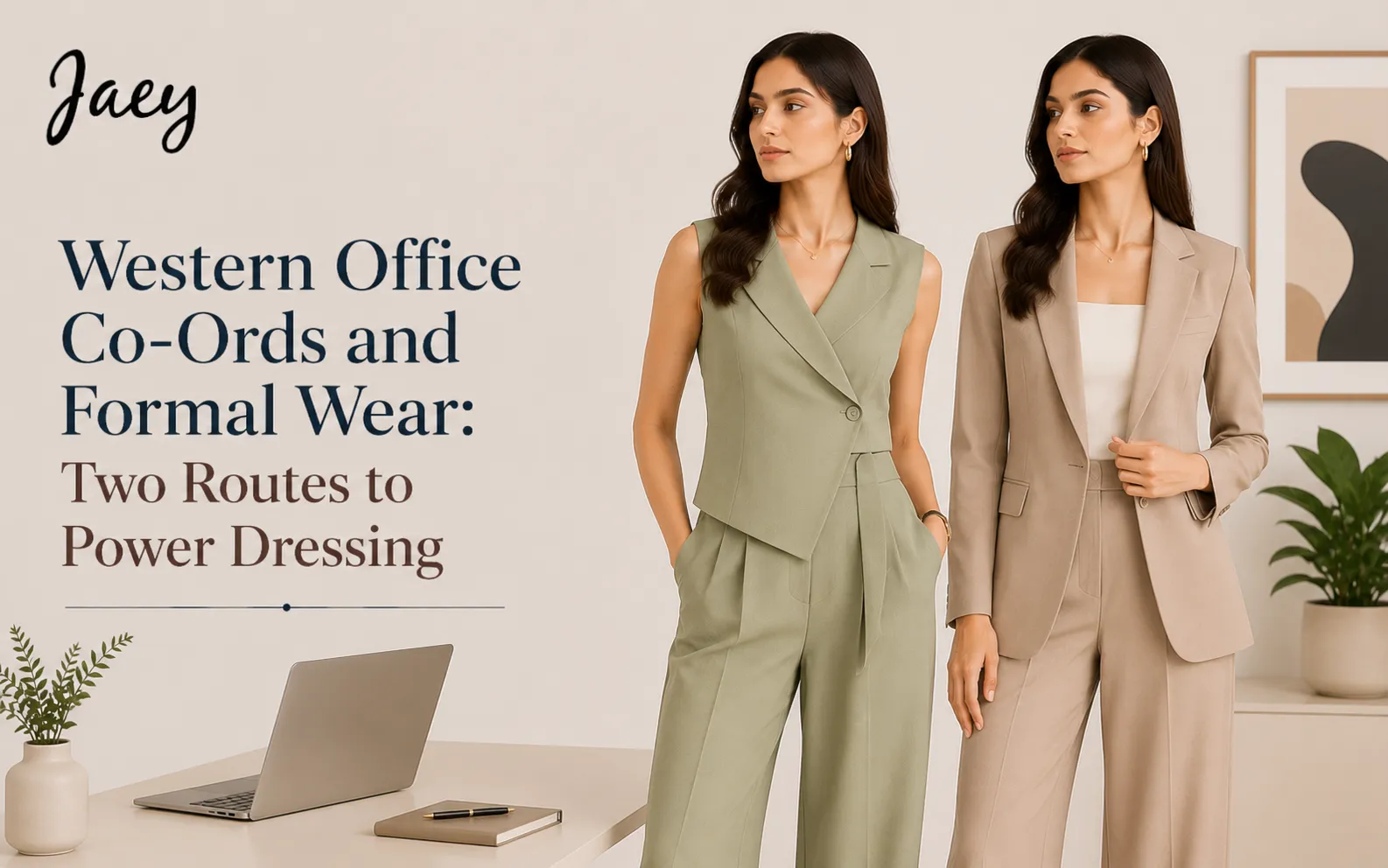
Power dressing has changed. It once suggested dark suits, sharp shoulders and a narrow set of acceptable choices. Modern authority can look structured, soft, colourful or minimal. What matters is that the clothes support the role and remain composed through the day.
Two useful routes are matching co-ords and adaptable western separates. One offers quick visual order. The other allows a wardrobe to respond to different meetings, climates and dress codes.
Why matching sets feel decisive
Well-planned co ord sets western office wear create a complete line without much effort. Matching colour and fabric reduce visual breaks. This can make the outfit feel calm and prepared.
The strongest office sets avoid unnecessary complexity. Trousers should sit cleanly at the waist. The top should remain secure when sitting. Pockets should lie flat rather than opening at the sides.
A set can still carry personality through an asymmetric hem, shaped collar, tie detail or unusual colour. The detail should not interfere with movement or make the outfit difficult to repeat.
Separates offer wider control
The broader category of western formal wear for ladies includes shirts, tops and trousers. It also includes dresses, skirts, blazers and waistcoats. Separates allow each part of the outfit to meet a different need.
A person may choose stretch trousers for travel. A light top may help during the commute. A blazer can be added in the meeting room. This control is useful in Indian weather, where outdoor heat and indoor cooling need different layers.
The trade-off is decision time. Separates need a clear colour and shape plan. Without it, the wardrobe can fill with single pieces that rarely work together.
Use a simple wardrobe framework
Start with two or three bottom shapes that genuinely fit. Straight trousers, wide trousers and a skirt may cover many needs, but there is no fixed formula. Some people will use only trousers. Others may prefer dresses.
Add tops that work with at least two bottoms. Then choose one or two outer layers. This creates a small network of outfits rather than isolated looks.
Co-ords can sit inside the same framework. Their trousers become another bottom, and their tops become another separate. A set becomes more valuable when both pieces join the rest of the wardrobe.
Fit communicates more than price
An expensive outfit can still look careless. Sleeves may be too long. Shoulders may collapse, or trousers may pull across the hips. A modestly priced garment can look composed when it fits well and receives proper care.
Check the hardest areas first. Shoulders and armholes are difficult to alter. Trouser waist and hem changes are often simpler. Buy for the area that matters most, then consider whether smaller adjustments are worthwhile.
Movement should be part of the fitting. Sit, walk, reach and use stairs. Power dressing loses its purpose if the person cannot move naturally.
Colour can be authoritative without being severe
Navy, charcoal and black remain useful because they combine easily. They are not the only professional colours. Deep green, chocolate, burgundy, muted blue and warm stone can look equally considered.
Bright colour can work when the cut is clean. A cobalt co-ord may need little jewellery. A strong red top may sit best under a neutral blazer. The colour should feel intentional rather than added to meet a trend.
Monochrome dressing can create a long, calm line. Tonal dressing uses related shades and feels softer. High contrast feels sharper and draws more attention to the boundaries between garments.
Dress for the actual room
Authority is understood differently across workplaces. A client presentation in finance may call for a restrained blazer and trouser. A leadership meeting in a creative business may welcome an unusual co-ord.
Observe the setting, but do not copy it blindly. Clothes should still feel natural to the wearer. A person may never feel at ease in a traditional suit. A clean set or dress may then support more confidence.
Video meetings create a smaller frame. Shoulder fit, neckline and colour near the face carry more weight. Large prints may distract on screen, while small details can disappear.
Keep the final styling quiet
Strong workwear rarely needs several statement accessories. One structured bag, a watch or small earrings may complete the look. Footwear should suit the commute and the surface of the workplace.
Garment care is part of presentation. Remove loose threads, repair hems and steam deep creases. Shoes and bags should be clean. These details often influence the finished effect more than another accessory.
Power dressing is not a costume and does not need to imitate masculinity. It is clothing that gives the wearer room to think, speak and move without distraction. Matching co-ords and western separates can both achieve that when they are chosen with purpose.
