

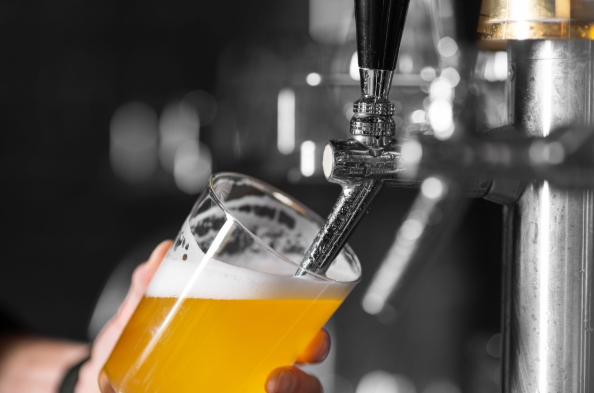
Beer looks simple in the glass. But behind every can or bottle is a process that involves precise chemistry, controlled temperatures, significant capital equipment, and a fair amount of waiting. India now has some of the most modern brewing facilities in Asia, and the process they follow is not very different from what you find in Germany or the Czech Republic though the scale and conditions are adapted for Indian raw materials and climate.
Here is a clear walk through of how beer actually gets made in a modern Indian brewery.
The Raw Materials
Every beer starts with four base ingredients: water, malted barley, hops, and yeast. In India, breweries often also use additional fermentable materials like rice or corn to lighten the body and keep production costs manageable at scale.
Malted Barley
Barley is the backbone of most beer styles. Before it can be used in brewing, the grain undergoes malting, a process where it is soaked in water, allowed to partially germinate, and then kiln-dried. This activates enzymes inside the grain that will later convert starches into fermentable sugars. India imports a significant share of its brewing barley from Australia and Canada, though domestic cultivation has grown in Rajasthan and Haryana.
Hops
Hops are the cone-shaped flowers of the Humulus lupulus plant. They add bitterness, aroma, and act as a natural preservative. India does not grow hops at commercial scale, the climate is not well suited so most brewing hops come from Germany, the United States, New Zealand, or the Czech Republic. The variety and quantity of hops used directly shapes the bitterness level, measured in International Bitterness Units (IBU).
Yeast
Yeast is the microorganism that drives fermentation converting sugars into alcohol and carbon dioxide. Lager yeast (Saccharomyces pastorianus) works at lower temperatures and settles to the bottom of the tank, which is why lagers take longer to ferment than ales. Most Indian commercial beers are lagers. Breweries maintain pure yeast cultures and repitch them across multiple batches.
Water
Water makes up more than 90% of beer. Its mineral content and the balance of calcium, magnesium, sulphate, and chloride directly affects taste. Modern breweries treat and adjust their water profile to hit consistent targets for each beer style.
The Brewing Process Step by Step
Step 1: Milling
The malted barley is first fed into a mill, which cracks the grain husks without destroying them. The goal is to break open the grain and expose the starchy interior while keeping the husks intact; they later act as a natural filter bed during lautering.
Step 2: Mashing
The milled malt goes into a mash tun, a large insulated vessel where it is mixed with hot water at temperatures between 62°C and 72°C. At these temperatures, the enzymes activated during malting break down the starches into fermentable sugars (mainly maltose) and non-fermentable dextrins. This liquid is now called the mash. The process takes about 60 to 90 minutes.
The temperature range matters: lower mash temperatures produce a more fermentable wort and a drier final beer; higher temperatures leave more dextrins and create a fuller-bodied beer.
Step 3: Lautering
Once mashing is complete, the liquid now called wort is separated from the spent grain in a vessel called a lauter tun. The grain husks form a natural filter bed. Hot water is sprinkled over the grain bed in a process called sparging to rinse out the remaining sugars. The spent grain is then sent off to be used as cattle feed, which is a common sustainability practice in Indian breweries.
Step 4: Boiling
The wort moves to a brew kettle and is brought to a rolling boil for 60 to 90 minutes. This is when hops are added. Hops added early in the boil contribute bitterness as their alpha acids isomerise under heat. Hops added later in the boil preserve more aromatic compounds. Boiling also sterilises the wort, drives off unwanted volatile compounds, and helps proteins coagulate and settle out.
Step 5: Whirlpooling and Cooling
After boiling, the wort enters a whirlpool vessel. The circular motion pushes the settled hop material and protein coagulants called trub into a cone at the centre of the vessel. The clear wort is drawn from the side. It then passes through a heat exchanger (plate cooler) and drops in temperature from near boiling to around 8°C to 12°C for lager fermentation. This happens in minutes.
Step 6: Fermentation
The cooled wort enters large cylindroconical fermentation tanks, where yeast is added (pitched). Lager yeast works best at temperatures between 8°C and 12°C. Over seven to fourteen days, the yeast consumes the fermentable sugars and produces ethanol, CO2, and a range of flavour compounds.
Mount Everest Breweries’ facility in Indore, Madhya Pradesh has one of the most modern canning and fermentation setups in the country with an installed capacity of 10 lakh hectolitres (equivalent to about 1.5 million cases per month). Maintaining precise temperature control across that scale requires significant refrigeration infrastructure.
Step 7: Conditioning (Lagering)
After primary fermentation, the beer moves into conditioning tanks at near-freezing temperatures typically between 0°C and 2°C. This lagering phase, which can last two to six weeks depending on the style, allows the beer to mature. Remaining yeast and proteins settle out, off-flavours dissipate, and the beer becomes clearer and smoother.
Step 8: Filtration
Most commercial Indian beers go through filtration to achieve clarity and remove any remaining yeast. Some breweries use diatomaceous earth (DE) filtration, while others use membrane filters. The goal is a bright, visually clear beer with a long shelf life.
Step 9: Carbonation and Packaging
The filtered beer is carbonated with CO2 to the target level, usually 2.5 to 2.7 volumes of CO2 for an Indian lager and then transferred to bright beer tanks. From there it flows to the canning or bottling line.
Modern canning lines, like the one operated by Mount Everest Breweries, fill and seal cans at very high speed thousands of cans per hour while minimising oxygen pickup. Oxygen is the enemy of fresh beer; even a small amount accelerates staling. After filling, the cans are pasteurised (flash pasteurisation or tunnel pasteurisation) to extend shelf life, then labelled, packed into cases and sent to the cold chain.
Quality Control at Every Stage
A modern Indian brewery runs quality checks throughout the process, not just at the end:
• Incoming raw material testing – Barley and hop lots are tested for moisture, extract, and alpha acid content
• Wort chemistry checks – Original gravity (OG), pH, and colour are measured after lautering
• Fermentation monitoring – Gravity, temperature, and yeast health are tracked daily
• Finished beer analysis – ABV, bitterness (IBU), colour (EBC), CO2 level, dissolved oxygen, and microbiological checks
This level of process discipline is what separates a consistent mass-market lager from a batch that might vary can to can.
Sustainability in Indian Brewing
The brewing industry generates significant water and energy use. Responsible breweries in India have started to address this directly. Mount Everest Breweries states a clear commitment to reducing, reusing, and recycling across their operations. Spent grain goes to cattle feed. Wastewater is treated on-site. CO2 recovered during fermentation is captured and reused for carbonation.
Water efficiency is particularly important in a country where water stress is a real concern across many states, including Madhya Pradesh where MEBL’s main facility operates.
From Indore to Your Glass
The next time you open a can of STOK whether it is the Lager, Strong, or Wheat the liquid inside has passed through eight or nine major process steps, been monitored at dozens of quality checkpoints, and travelled from a grain field in Rajasthan or Australia to a canning line in central India to a shelf near you.
Brewing is not magic. It is controlled science. And the best Indian breweries do it with the same discipline you find anywhere in the world.
For readers interested in the company’s financial growth, expansion strategy, and shareholder updates, Mount Everest Breweries also maintains a dedicated brewery investor relations section for investors and stakeholders.
