
India’s alcohol industry is one of the most closely watched consumer sectors in the country right now. The numbers are significant, the growth trajectory is clear, and the composition of the market is changing at a pace that has caught the attention of both domestic companies and international players.
Here is a grounded look at where the market stands in 2026, how it got here, and who the key players are.
Market Size: What the Numbers Say
The Indian alcohol market was valued at approximately USD 68.5 billion in 2025. Current projections put the market on track to reach around USD 131 billion by 2035, growing at a compound annual growth rate (CAGR) of roughly 6.7%.
To put this in rupee terms: the market is estimated at over Rs 5.3 lakh crore in FY2026, growing at an annual rate of 8 to 10 percent by value, driven in significant part by premiumisation consumers trading up from lower-priced options to mid-range and premium brands.
India’s total beverage alcohol volume grew 7% in the first half of 2025, making it one of the fastest-growing alcohol markets in the world. At current growth rates, India is on course to become the world’s fifth largest alcohol market by 2031.
How the Market Breaks Down
Spirits Dominate
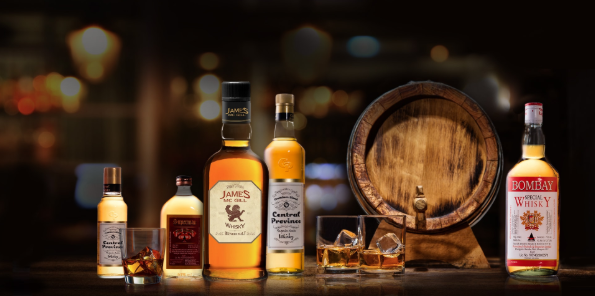
Spirits which include Indian Made Foreign Liquor (IMFL) such as whisky, rum, vodka, brandy, and gin account for roughly 74% of the market by value. Whisky alone makes up nearly two-thirds of all spirits sold. India is the largest whisky-consuming nation on earth, and domestic brands have built enormous distribution and brand loyalty across price tiers.
The spirits segment continues to grow, driven by:
• Rising middle-class incomes with more discretionary spend
• Younger consumers in Tier 1 and Tier 2 cities trading up from economy to mid-range and premium IMFL
• Indian single malts gaining recognition, Rampur Indian Single Malt and Amrut are now sold in over 60 countries
• Craft gin gaining traction among urban consumers, brands like Greater Than and Hapusa have built strong followings
Beer: High Volume, Strong Growth
Beer is the second-largest category. The Indian beer market is currently valued at around USD 9 billion and could grow to USD 14 to 15 billion in the coming years. Despite India’s large population, per capita beer consumption remains low by global standards around two litres per person per year. This signals significant headroom for growth.
Growth drivers in beer include:
• Young urban consumers choosing beer as a lower-ABV entry point to alcohol
• Growth of organised pubs, microbreweries, and the nightlife ecosystem in metros and Tier 1 cities
• Craft lagers, wheat beers, and IPAs gaining shelf space alongside mainstream strong lagers
• Premiumisation within beer craft brands like STOK, by Mount Everest Breweries, addressing consumers who want more than a standard lager
Wine: Small but Growing
Wine remains a small part of the overall market but is growing at a faster pace than the category average. Domestic wine production concentrated in Nashik, Pune, and parts of Karnataka has improved in quality. Urban, health-conscious consumers are increasingly choosing wine over spirits for social occasions. Still, wine accounts for less than 5% of total alcohol sales by volume.
Key Players in the Indian Alcohol Industry
Associated Alcohols and Breweries Limited (AABL)
Associated Alcohols and Breweries Limited (AABL) is a Madhya Pradesh-based company with a grain-based distillery setup and contract manufacturing capabilities. The company produces IMFL, Extra Neutral Alcohol (ENA), and operates as a contract manufacturer for several larger brands. AABL’s strength lies in its cost-efficient production model and growing bottling capacity. As India’s organised alcohol market expands, ENA-focused manufacturers like AABL are positioned to benefit from increased contract manufacturing demand from both domestic and international brands entering the market.
Mount Everest Breweries Limited (MEBL)
MEBL, established in 1999 and operating out of Indore, is the brewery behind the STOK beer brand. With a partnership with United Breweries that has helped maintain global quality standards, and a brewery capacity of 10 lakh hectolitres per annum, MEBL has positioned itself as a credible craft and premium challenger in the beer segment. Recent expansion into Goa and Maharashtra signals ambition to grow its market footprint.
United Spirits Limited (Diageo India)
United Spirits, majority owned by Diageo PLC, is the largest spirits company in India by volume. Its portfolio covers virtually every price tier from McDowell’s No. 1 and Royal Challenge in the mass segment to Black Dog and Johnnie Walker in premium. In June 2025, Diageo India acquired NAO Spirits, the maker of craft gins Greater Than and Hapusa, signalling a direct move into the craft segment.
United Breweries Limited
UBL, the maker of Kingfisher beer, dominates Indian beer by volume and distribution reach. Heineken holds a controlling stake in the company. Kingfisher remains the most widely distributed beer brand in the country. UBL also produces and distributes spirits under various brand licences.
Pernod Ricard India
The Indian subsidiary of Pernod Ricard is a major force across premium and ultra-premium spirits Royal Stag, Seagram’s, Chivas Regal, Ballantine’s, and Absolut Vodka are all in its portfolio. Pernod Ricard has invested in building premium retail experiences and brand-led events across metro markets.
Radico Khaitan
Radico Khaitan is one of India’s largest IMFL producers and one of the oldest distilleries in the country. It has successfully built a premium portfolio alongside its volume brands 8 PM Premium Black Whisky, Morpheus Brandy, and Magic Moments Vodka are mainstream stalwarts. The company entered the Indian single malt space with Rampur, which has performed well in export markets.
Allied Blenders and Distillers (ABD)
ABD is the maker of Officer’s Choice whisky, which by some measures is one of the highest-volume whisky brands in the world. The company operates across budget and mid-range segments with a wide distribution network, particularly strong in rural and semi-urban markets.
The Premiumisation Trend
The single most important structural shift in India’s alcohol market right now is premiumisation. Consumers are not just drinking more, they are spending more per unit. Premium and above price categories grew 8% in volume in the first half of 2025, slightly ahead of the 7% overall market growth. This trend is most visible in:
• Indian single malt whisky — Where domestic brands compete with Scotch imports
• Craft gin — Which has seen the most rapid brand launches in the last three years
• Craft and specialty beer — Where wheat beers, IPAs, and craft lagers are gaining distribution in premium retail and food service
• Ready-to-drink (RTD) cocktails — Increasingly popular among younger consumers and women
Regulatory Landscape
Alcohol in India is a state subject under the Constitution. This means each of the 28 states sets its own excise policy, licence fees, pricing, and distribution rules. The result is a fragmented regulatory environment that adds significant compliance complexity for manufacturers.
States like Karnataka, Maharashtra, Goa, and Delhi have relatively open markets with organised retail and licensed bars. States like Bihar and Gujarat have full prohibition. Tamil Nadu operates state-controlled retail through TASMAC. This patchwork means a company must navigate 28 different regulatory systems to sell nationally.
Industry bodies and market participants continue to push for rationalisation particularly on inter-state movement of alcohol and GST inclusion, which remains unresolved.
Online Delivery: A New Growth Channel
One of the newer growth vectors in India’s alcohol market is licensed online delivery. Delhi, Karnataka, Haryana, Punjab, and several other states have introduced regulated online alcohol delivery, initially focused on beer and wine. Platforms like Swiggy and Zomato now operate licensed alcohol delivery in eligible cities with age verification checks built in. This channel is still in early stages but has strong growth potential as it addresses urban consumers’ preference for convenience.
What to Watch in 2026 and Beyond
• Continued growth in craft and premium segments across beer, gin, and single malt whisky
• More international brands entering through partnerships with Indian distilleries and breweries
• State-level regulatory reforms particularly in Maharashtra and Karnataka that could open organised retail further
• Expansion of microbreweries in Tier 2 cities as licensing becomes more accessible
• Sustainability becoming a real procurement criterion – Water usage, packaging, and supply chain transparency all under scrutiny
India’s alcohol industry is no longer just a volume story. It is a valuable story. The companies that build brand equity in the premium and craft tiers now whether they are large IMFL manufacturers like AABL, craft brewers like MEBL, or spirits houses like Radico are the ones best placed to capture the market’s next growth phase.
